
Pranjul Bhandari, Chief India Economist, HSBC, speaks about a range of issues ranging from inflation, to how Goods and Services Tax and land acquisition bills can help India hit double digit growth, and her impressions about economic growth in the last one year after Narendra Modi took over as India's Prime Minister.

Here's the full text of President's Ram Nath Kovind's address to the joint sitting of both houses of Parliament on the first of Budget Session 2022.

For now, the upside appears to offset damage done to exports by weaker global demand.

Signs of a strong pickup in hiring by companies are adding to the rosier outlook for Indian households.

'What we need is right skilling, re-skilling and up-skilling.'

The industry players couldn't hide their disappointment.
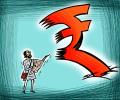
'Obviously, there is always an argument that a weaker rupee could push up, to some, extent exports.' 'The fact that the rupee has appreciated against the Chinese currency is pushing a lot of Chinese imports into the Indian market.'

Times without count we have bought more complex procedures in the name of simplification, says Shreekant Sambrani.

At the end of 2018-19, the Tata group had a consolidated debt of Rs 2.77 trillion. Tatas not only plan to avoid big-ticket acquisitions for now, the group's main focus will be on improving key metrics and reduce debt, say Shally Seth Mohile & Dev Chatterjee.

The policy statement by the RBI governor is also expected to be upbeat.
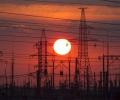
In an interview with Sanjay Jog, REC chairman and managing director P V Ramesh talks of the growth strategy and the company's plan to ride the transformation wave in the power sector.

'Physically, he is your boy next door, but attitude-wise, he is an evangelist who does not mind shouting from the rooftops to take a stand on a cause he believes in.'

Operating margins decline to 10.3% in March quarter on one-time payouts but may recover to 12% in FY2015.

Netflix and Amazon Prime are raising their stakes in the game, commissioning original shows and going all out to acquire regional films for their libraries.
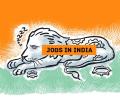
'You can't take jobs to people, you have to take people to jobs.'
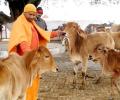
If the fight against black money seems half hearted, the same is not the case with gau raksha, says Subir Roy.

Many things could play spoilsport for the Indian economy.

The larger virtue of maintaining fiscal credibility should not be unduly diluted by quibbles on the fiscal math, says Sajjid Chinoy.

M Muneer recommends segmenting the population on the basis of their propensity to embrace new technologies is the key to driving digitisation.

Nivedita Mookerji finds out how Paytm CEO Vijay Shekhar Sharma is handling his soaring popularity after the note ban as well as the criticism that comes as a package deal.
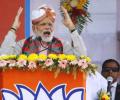
Nationalism, Hindutva, and war on corruption, not growth, will define Modi's politics until 2019.

'The Indian economy has been subsidised by the poor.'

Rajasthan has taken the lead on structural reforms which could help India attract business and employ a fast-growing workforce.
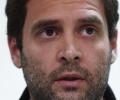
Following is the full text of Congress vice-president Rahul Gandhi's speech at FICCI's 86th annual general meeting on Saturday:

Most adult Indians should have access to bank deposits, credit and remittance facilities as well as insurance and mutual fund products in the next decade, and technology will play a big role in this transformation, says Tamal Bandyopadhyay.

Think organic food, affordable homes, artificial intelligence, suggests Prof Manmeet Barve.

The temptation to rehash Manmohanomics is not going to deliver the achche-din that Narendra Modi has promised, warns Sriram Balasubramanian.

Rather than move up the echelons of finance management, he was part of crisis management at his first employer, and then the commercial head of home and personal care products and, lately, chairman of Middle East and North Africa for Unilever, the second-largest fast-moving consumer goods company in the world.

Two young designers from Meghalaya are making a positive impact with their skills.

India must first improve working condition, then it can concentrate on Make in India concept.
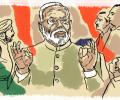
Kamal Nath argued that Modi had 'overexposed himself': By constantly pushing his own image on social media and on TV, attaching his name to multiple promises, Modi had become the face rivals could easily blame for India's chronic dysfunction.

'Demonetisation, is in principal, a mistake, because it involves a theft -- a taking of private property by the State.' 'It is one of those bad Indian ideas that has been tried twice in the past, with two failures for the record books.' 'This cloud over the economy will probably remain as long as Modi is in power.'
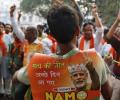
'Success will require political skill, not just economic expertise'

India Inc has few leaders who are likely to grab headlines in 2015.

Advertising taglines such as 'Bright in studies, bright in sports' attempted to drive home the message that Bournvita, a chocolate drink, could build a child's mental and physical faculties.
He also affirmed that over time, as the government finances improve, the SLR will be brought down further.

Money is being released and the government knows it will have to front-run private investment.

A data plan currently priced at Rs 100 should not cost more than Rs 34, if India has to make the Internet affordable for 80 per cent of its population.
Demonetisation hit informal sector hard and caused job losses which was not addressed by the budget, Moily said.

SBI had a tough journey in the last 40 years.
